

Page Title: Economic Impacts of Car-Lite Streets
Economic Impacts of Car-Lite Streets
Section: Intro
Are Car-Lite (or Car-free) Streets Good for Business?
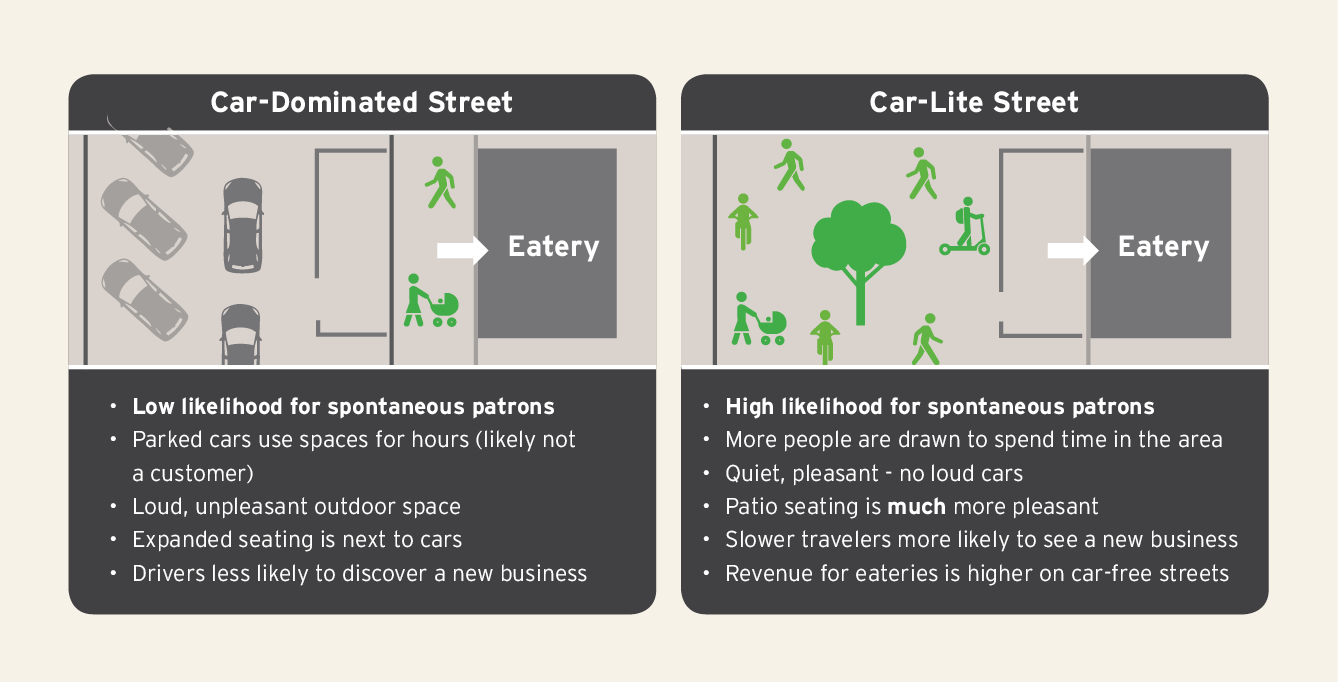
This might surprise you, but yes! Think of pedestrian-friendly plazas in Europe, or a car-free block for shopping and dining - places without cars are much quieter, safer and more enjoyable. And they attract shoppers and diners more than streets with heavy or normal traffic. Check out the research below.
Section: Articles and References
👉 ALSO – Check out our downloadable pdf summary of these economic benefits!
The Business Case for Car-free Streets
"At first, the empty city streets of the pandemic were an eerie sign of a world in disorder. But when dozens of cities converted some of them to pedestrian-friendly corridors with restricted vehicle access, they became something else: an example of how readily urban space can be repurposed for mobility and play, and how quickly human activity can surge back when cars are removed.
Now local officials are weighing whether to keep these temporary installations — known variously as “safe streets,” “slow streets,” “open streets,” and “stay healthy streets,” among other labels — in place for the long haul. A survey of 43 member cities of the National Association of City Transportation Officials found that 22 were planning on making Covid-era traffic changes permanent, while 16 more were considering it. At the end of April, New York City passed a bill making its Open Streets program — the most extensive in the U.S. — permanent, and California is mulling legislation that would streamline that process.
But pedestrian-friendly street redesigns often face resistance from business owners, who fear that they’ll lose revenue from inconvenienced drivers. A new data analysis by Yelp adds some fresh insights into what really happens to local commerce when vehicle traffic is kept out." more >
Bloomberg.com, May 11, 2021 by Laura Bliss
Investing in Pedestrian Areas Multiplies Local Income
"Pedestrianizing or 'pacifying' streets increases local revenues for municipalities and businesses, reduces pollution, protects health and improves children's autonomy. Towns around the world are opting for more humane cities. " more >
The Business Case for Active Transportation
"Pedestrian improvements can greatly improve retail sales and generate increased sales and property tax revenues.
A survey of cities around the world, concerning their pedestrianisation schemes, revealed environmental improvement closely related to the removal of traffic. The survey also showed that 49% of all the pedestrian areas developed experienced an upward trend in retail turnover, while only 2% experienced a decrease." more >
NACTO, March 2004, Richard Campbell, Margaret Wittgens
Bellingham Transportation Fund Storymap
Summary of all work completed in Bellingham since 2010 for projects funded by our Bellingham Transportation Fund
Bellingham Interactive Bike Facility map (arc gis)
Bellingham Pedestrian Plan
Bellingham Bicycle Plan
Bellingham ADA Transition Plan
Transportation Annual Report on Mobility (TRAM)
Transportation Improvement Program (TIP)
Transportation Planning page
Transportation Commission
Q: Where do I look to see if a project location is on the list? A.(Insert links to chapters in Bike & Ped Plans)
Q: How do I report a maintenance issue, for example a pothole in a bike lane? Use SeeClickFix to report the problem and track progress.
Q: Who do I call if private landscaping or debris is blocking a sidewalk? A. Public Works Operations office: (360) 778-7700
Q: Who do I call if there is bike lane blockage? A: Main desk # for Police: (360) 778-8800 OR For general parking problems or questions email parksmart@cob.org
Q: How can I find out about transit service in my neighborhood? Whatcom Transportation Authority (WTA).
Safety: Improve pedestrian safety through well-designed facilities along and across roadways, and by promoting safe driving, walking, and bicycling behaviors.
Equity: Provide accessible pedestrian facilities for all through equity in public engagement, service delivery, and capital investment.
Health: Develop a pedestrian network that promotes active, healthy lifestyles and sustains a healthy environment.
Economic Sustainability: Enhance economic vibrancy by creating a safe and aesthetically pleasing walking environment with easy connections to commercial centers and inviting public places for people to socialize.
Connectivity: Provide a citywide network of accessible, efficient, and convenient pedestrian infrastructure that connects homes, jobs, shopping, schools, services, and recreation areas using sidewalks, crosswalks, shared-use paths, bridges, tunnels, and signage.
Multi-Modal Transportation: Develop high-quality pedestrian facilities that provide access to all other modes of transportation.
Land Use and Site Design: Employ land use planning and site design requirements that are conducive to pedestrian travel and result in a mode shift away from automobile trips to walking trips.
Safety: Improve safety of bicyclists by promoting safe bicycling, driving, and walking behaviors and building appropriate, well-designed facilities.
Connectivity: Complete a connected network of bikeways linking and providing access to all neighborhoods and key destinations.
Equity: Provide bicycling access for all through equity in public engagement, service delivery and capital investment.
Livability: Build a vibrant and healthy community by creating a welcoming environment for bicycle riding.
Public and Environmental Health: Develop a bicycle network that enables active, healthy lifestyles and sustains a healthy environment.
Choice: Develop infrastructure that creates viable transportation choices, and accommodates multimodal trips.
Education: Provide education on the rights and responsibilities of the users of all transportation modes.
Mode shift: Increase the number and percent of bicycle trips citywide. ii Bellingham Bicycle Master Plan – Executive Summary
Economy: Enhance economic vibrancy by creating a bicycle friendly community that is an attractive place to live and work.
Bellingham-specific Links
Bellingham Transportation Fund Storymap
Summary of all work completed in Bellingham since 2010 for projects funded by our Bellingham Transportation Fund