

Page Title: Economic Impacts of Bike Lanes
Economic Impacts of Bike Lanes
Section: Articles and References
Are Bike Lanes Good for Business?
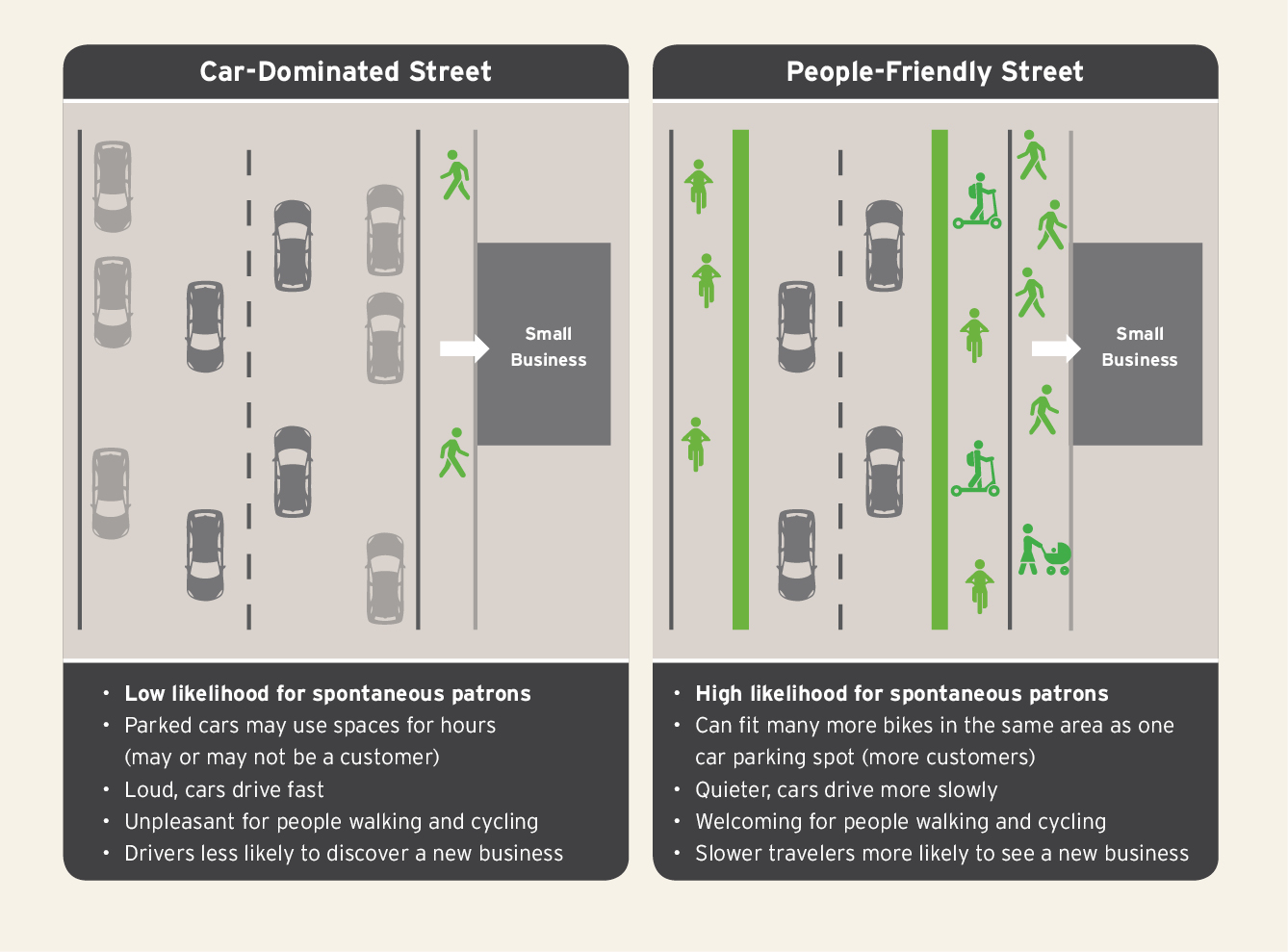
There is often debate about whether adding bicycle facilities in a retail district will affect business, especially if those bike lanes are installed at the expense of parking or a driving lane. We turn to research, data and reporting in other cities to help us answer this question. See what the experts say, and follow the links for complete articles. TLDR: they're good for business, or at the very least - neutral.
Section: Articles and References
👉 ALSO – Check out our downloadable pdf summary of these economic benefits!
Bike Lanes are good for Business
Businesses hate bike lanes. Sure, they reduce pollution, slow the pace of climate change, cut traffic fatalities, and make cities healthier and more pleasant. But they also take away parking spaces, which makes it tougher for shoppers to load up their cars with piles of stuff. Freaked-out business owners have been fighting bike lanes coast to coast, in cities from San Diego to Cambridge, Massachusetts. They worry — not unreasonably — that anything that makes it harder for customers to get to their stops will eat into their already precarious margins.
“As someone whose family had a small business when I was growing up, I know how invested you get in it,” says Joseph Poirier, a senior researcher at the urban-planning consultancy Nelson Nygaard. “It’s your whole life. Anything you think could threaten that, even if the government and their consultants tell you it’s not going to be a problem, is very scary. It makes sense.”
It’s also wrong. Four decades’ worth of research proves it. I know this because I’ve read every study and report I could find that looked specifically at the economics of bike lanes since 1984 — 32 research articles, to be exact. The results show that making streets friendlier for bikes — and sidewalks friendlier for pedestrians — is actually good for business. The rise of “complete streets” and “road diets,” as urban planners call them, has been a huge boon to businesses in cities. more >
Business Insider. Mar 7, 2024 by Adam Rogers
Economic Impacts on Local Businesses of Investments in Bicycle and Pedestrian Infrastructure: a Review of the Evidence
Abstract: Local officials in North America frequently face opposition to new or expanded bicycle or pedestrian facilities. The most vocal opponents are usually motorists and local business owners who fear that the removal of or reductions in vehicular parking or travel lanes will reduce patronage from motorists and that any increased patronage from pedestrians or cyclists will not offset the lost revenues. A lack of direct evidence on the economic impacts of facilities on local businesses has made it difficult to support or debunk such fears. A lack of quantitative evidence in particular has prevented the incorporation of such impacts into cost–benefit analyses. The issue has received enough attention from researchers in recent years that a review of the evidence is now warranted. We reviewed the relevant literature and identified 23 studies, focusing on the US and Canada, that either (1) quantified and compared consumer spending between active travellers and automobile users (n = 8), or (2) quantified an economic impact to local businesses following the installation of bicycle or pedestrian facilities (n = 15). Taken together, the studies indicate that creating or improving active travel facilities generally has positive or non-significant economic impacts on retail and food service businesses abutting or within a short distance of the facilities, though bicycle facilities might have negative economic effects on auto-centric businesses. The results are similar regardless of whether vehicular parking or travel lanes are removed or reduced to make room for the active travel facilities. The studies also highlight best practices for designing future research. Ten of the 15 studies that quantified an economic impact to local businesses used both before-and-after data and comparison sites or other statistical controls for variables unrelated to the active travel facility “treatment;” six of those used statistical testing.
Bike Lanes Can Provide Positive Economic Impact in Cities
According to a new study released by Portland State University’s Transportation Research and Education Center in Oregon, bicycle lanes and infrastructure can produce tangible economic benefits for cities.
The National Street Improvements Study, conducted by PSU in conjunction with PeopleForBikes and consulting firm Bennett Midland and funded in part by The Summit Foundation, researched the economic effects of bicycle infrastructure on 14 corridors across six cities — Portland, Seattle, San Francisco, Memphis, Minneapolis and Indianapolis. The study found that improvements such as bicycle and pedestrian infrastructure had either positive or non-significant impacts on the local economy as measured through sales and employment.
For example, in 2012, bike lanes were installed on Central Avenue in Minneapolis by reducing the width of the travel lane and removing parking lanes. Retail employment increased by 12.64% — significantly higher than the 8.54% increase calculated in the control study area a few blocks away. The same corridor also recorded a dramatic 52.44% increase in food sales, which more than doubled the 22.46% increase in the control area. A protected bike lane along Broadway in Seattle that was completed in 2014 was accompanied by a significant 30.78% increase in food service employment compared to 2.49% and 16.17% increases in control areas.
The study found that the food service businesses benefited most from the addition of bicycle and pedestrian infrastructure. Evidence of increased sales, employment and wages was observed in nearly all of the city corridors studied, even in cases in which a motor vehicle or parking lane was removed to install a bike lane. more >
Portland State University, Transportation Research and Education Center. April 22, 2020, by Lacey Friedly
Active Transportation Projects Offer Solid Returns on Investment, Economic Study Finds
Active transportation investments offer many types of benefits related to safety, reduced greenhouse gas emissions, physical activity and the economy. Metro, Oregon’s regional government for the Portland metropolitan area, wants to better understand the role of these investments in building stronger communities in their region.
Led by Portland State University in partnership with Metro, the Active Transportation Return on Investment (ATROI) study looked at twelve projects constructed in the greater Portland region between 2001 and 2016. These twelve 2040 Catalyst Projects were evaluated to determine if active transportation investments had significant effects on the local economy. 2040 Catalyst Projects retrofit busy commercial streets with pedestrian-friendly treatments to catalyze economic development within 2040 Centers, Main Streets, or Station Communities.
Redesigned streets can improve economic conditions by creating attractive and walkable business districts, providing access to various destinations, local businesses, and jobs. Nearly all the projects focus primarily on pedestrian improvements, such as improved sidewalks (new, widened, etc.), safer crossings (signals, rectangular rapid flash beacons, curb extensions, crosswalks, signage, ramps, etc.), improved bus stops, landscaping (trees, bioswales for stormwater management, etc.), lighting, and public art. A few projects also included new or restriped bike lanes, shared lane markings, and/or bike parking.
Overall, the research team found positive effects on business activity in the retail and/or food sectors, demonstrating that the potential economic benefits are not just in more urban parts of the city of Portland:
- 75% of the project locations saw measurable economic gains in the food or retail industries after implementation.
- Layering complementary investments (e.g. light rail stations and transit oriented-development) has the potential to yield the greatest benefits.
- The projects that did not see positive effects tended to have higher traffic volumes and/or speeds. Projects are more likely to reach their full potential when they reduce the effects of an auto-oriented environment and create places for walking that are also less stressful and more comfortable.
"The findings reveal that these types of investments can have positive outcomes in places outside of downtown and inner Portland, particularly when coupled with other planning and infrastructure investments, but that we do need to address the negative effects of high speed, multi-lane arterials," Dill said. more >
Bellingham Transportation Fund Storymap
Summary of all work completed in Bellingham since 2010 for projects funded by our Bellingham Transportation Fund
Bellingham Interactive Bike Facility map (arc gis)
Bellingham Pedestrian Plan
Bellingham Bicycle Plan
Bellingham ADA Transition Plan
Transportation Annual Report on Mobility (TRAM)
Transportation Improvement Program (TIP)
Transportation Planning page
Transportation Commission
Q: Where do I look to see if a project location is on the list? A.(Insert links to chapters in Bike & Ped Plans)
Q: How do I report a maintenance issue, for example a pothole in a bike lane? Use SeeClickFix to report the problem and track progress.
Q: Who do I call if private landscaping or debris is blocking a sidewalk? A. Public Works Operations office: (360) 778-7700
Q: Who do I call if there is bike lane blockage? A: Main desk # for Police: (360) 778-8800 OR For general parking problems or questions email parksmart@cob.org
Q: How can I find out about transit service in my neighborhood? Whatcom Transportation Authority (WTA).
Safety: Improve pedestrian safety through well-designed facilities along and across roadways, and by promoting safe driving, walking, and bicycling behaviors.
Equity: Provide accessible pedestrian facilities for all through equity in public engagement, service delivery, and capital investment.
Health: Develop a pedestrian network that promotes active, healthy lifestyles and sustains a healthy environment.
Economic Sustainability: Enhance economic vibrancy by creating a safe and aesthetically pleasing walking environment with easy connections to commercial centers and inviting public places for people to socialize.
Connectivity: Provide a citywide network of accessible, efficient, and convenient pedestrian infrastructure that connects homes, jobs, shopping, schools, services, and recreation areas using sidewalks, crosswalks, shared-use paths, bridges, tunnels, and signage.
Multi-Modal Transportation: Develop high-quality pedestrian facilities that provide access to all other modes of transportation.
Land Use and Site Design: Employ land use planning and site design requirements that are conducive to pedestrian travel and result in a mode shift away from automobile trips to walking trips.
Safety: Improve safety of bicyclists by promoting safe bicycling, driving, and walking behaviors and building appropriate, well-designed facilities.
Connectivity: Complete a connected network of bikeways linking and providing access to all neighborhoods and key destinations.
Equity: Provide bicycling access for all through equity in public engagement, service delivery and capital investment.
Livability: Build a vibrant and healthy community by creating a welcoming environment for bicycle riding.
Public and Environmental Health: Develop a bicycle network that enables active, healthy lifestyles and sustains a healthy environment.
Choice: Develop infrastructure that creates viable transportation choices, and accommodates multimodal trips.
Education: Provide education on the rights and responsibilities of the users of all transportation modes.
Mode shift: Increase the number and percent of bicycle trips citywide. ii Bellingham Bicycle Master Plan – Executive Summary
Economy: Enhance economic vibrancy by creating a bicycle friendly community that is an attractive place to live and work.
Bellingham-specific Links
Bellingham Transportation Fund Storymap
Summary of all work completed in Bellingham since 2010 for projects funded by our Bellingham Transportation Fund